Published Editorial Work
Click on an image to learn more.

Founder and Editor-in-Chief

Editor-in-Chief and Globe Editor
Editor
Editor-in-Chief

Secondary Editor
Primary Editor
Before-And-After Edits
Before: Everything that I had dreamed of finally came true. My novella, which I had spent the previous summer poring over, waking up at three in the morning to add a scene that I’d just dreamt about, was about to be published; I’d been interning at Simon & Schuster, where my boss—and her boss and her boss’s boss—loved me and I got to watch TikToks for most of my work; Penguin Random House just accepted me into their Copyediting and Proofreading Mentorship program. Becoming a published author and working for not one but two of the Big 5 publishing houses, dreams I have held close to my heart since I was in the fifth grade, dreams that kept me motivated through some of the darkest and most troubling times of my life, had come to fruition. And I couldn’t care less about them.
Truth be told, I didn’t even view them as accomplishments. They felt more like they were burdens to me. Tasks that ate away at my free time. Responsibilities that mattered more than sleeping and eating. Yes, these were some of my biggest dreams, dreams that I worked so tirelessly toward, dreams that I sacrificed so much for, but they also became sacrifices, and, in the end, they were part of the reason for why I relapsed in my eating disorder and developed gastritis. The time of my life where I should’ve been the happiest, should’ve been so proud of myself for what I proved I could do, was when I felt so miserable, so worn out, and so useless.
I am getting ahead of myself, though; first, I’d like to paint a picture of my typical week during this time. On top of taking four classes, I worked at the WARC, interned at Simon & Schuster for sixteen hours a week—although, I never really “stopped” because I’d answer emails, tweak influencer pitches, and jotted down post ideas whenever I could—was a part of three organizations, two of which I was on the Eboard for, and oversaw the publishing process of my novella. Every day, for three months, I would leave my dorm room at eight in the morning and return at nine at night. And the cycle would repeat. Over and over and over. Even on the weekends, I’d spend twelve hours at the library completing the homework I didn’t have the time for during the week. I barely saw my friends or spoke with my family. One day, when brushing my teeth before going to bed, I realized that I had patches of gray hair poking out of my scalp; during class, I’d pluck them out, one by one, but they kept coming back.
Trying to remember this time is difficult for me because I really wasn’t living. I was stretched thin and continuously placed unreachable expectations on my own shoulders. Sure, I’m interning at a “Big 5” publisher, but if I make one mistake, say one embarrassing sentence, or finish a task one minute too late, then everything will come crumbling down, crushing me. Great, my novella is being published, but what will others think of it? Will they find my writing juvenile and sloppy? The story confusing and boring? Why did I have to put so much effort into a story that could never be good enough? When will Penguin Random House realize how stupid I truly am? That they made a mistake in choosing me over more qualified, capable candidates? I’m only being published, only an intern and future mentor, because of the pity others feel for me. I have nothing to be proud of. I am nothing.
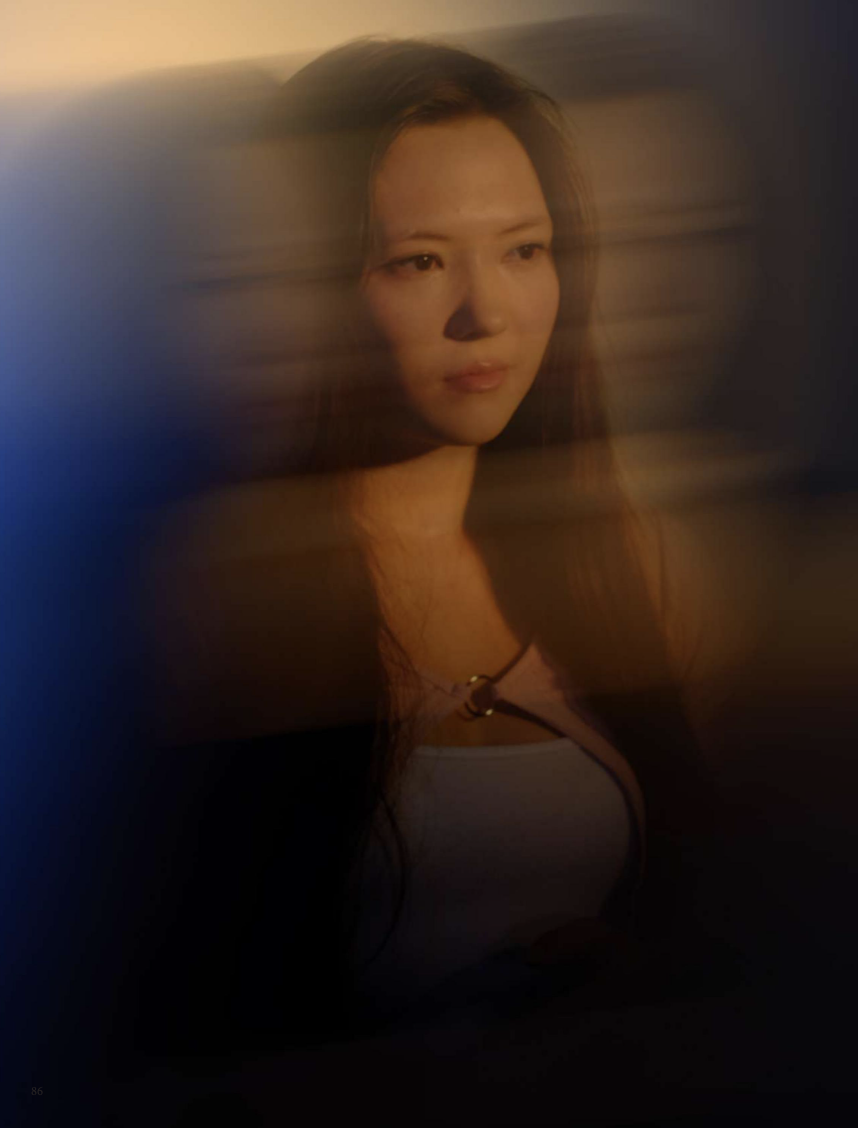
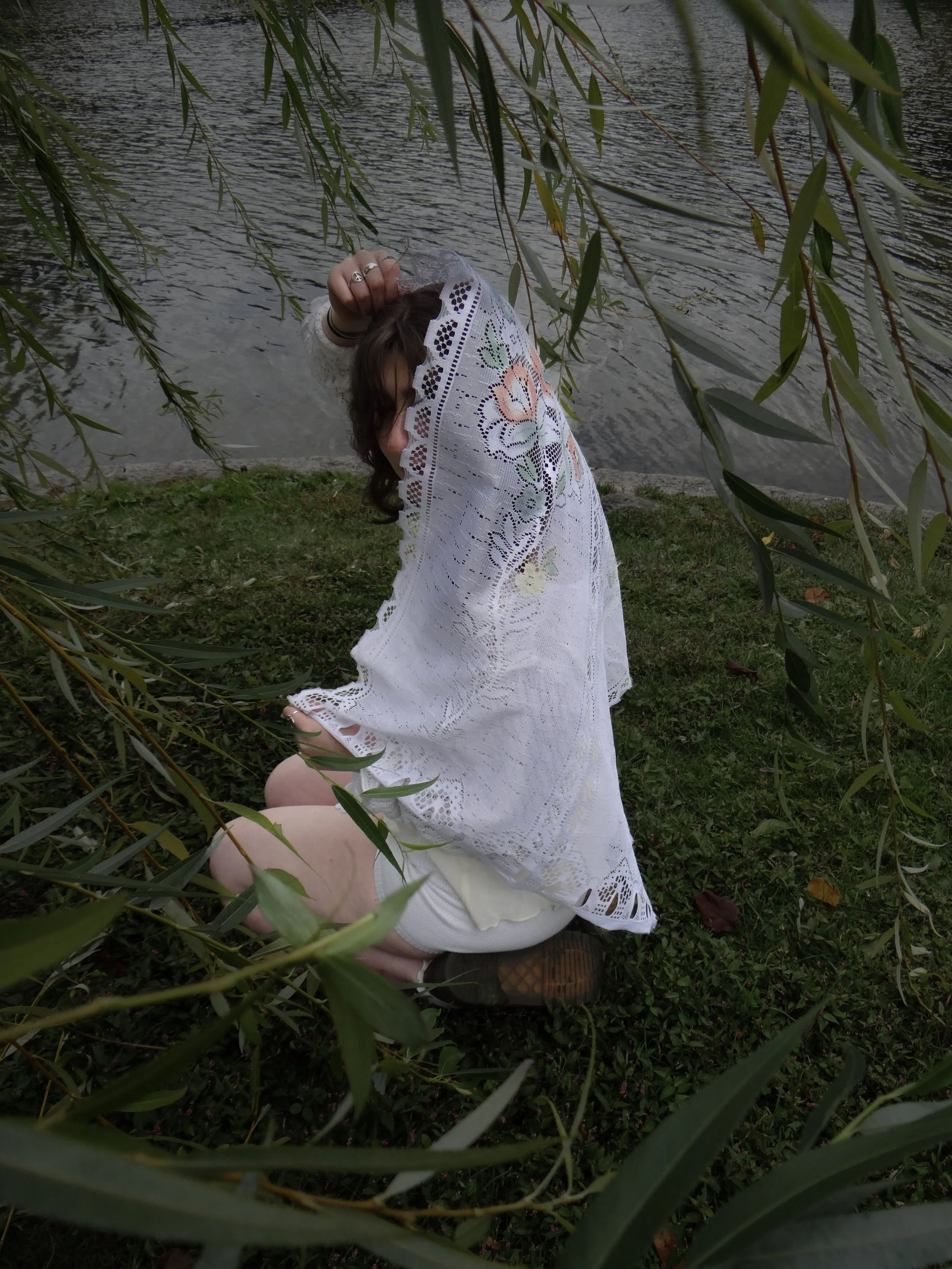
All of This (Originally Tummy Issues) by Liz Gómez
Atlas Magazine: The “Contortion” Issue, December 2025.
After: Everything that I had dreamed of finally came true. My novella, which I had spent the previous summer poring over, waking up at three in the morning to add a scene that I’d just dreamt about, was about to be published; I’d been a marketing intern at Simon & Schuster, where my boss—and her boss and her boss’s boss—loved me and I got to watch TikToks for most of my work; Penguin Random House had just accepted me into their Copyediting and Proofreading Mentorship program. Dreams I have held close to my heart since I was in the fifth grade, dreams that kept me motivated through some of the darkest and most troubling times of my life, had come to fruition. And I couldn’t care less about them.
I didn’t even view them as accomplishments. To me, they felt more like burdens. Yes, these were some of my biggest dreams, but they also became sacrifices, and, in the end, they were part of the reason why I relapsed in my eating disorder and developed gastritis.
I am getting ahead of myself, though; first, I’d like to paint a picture of my typical week during this time. On top of taking four classes, I worked at the Writing and Academic Resource Center (WARC), interned at Simon & Schuster for sixteen hours a week—although, I never really “stopped” because I’d answer emails, tweak influencer pitches, and jotted down post ideas whenever I could—was a part of three on-campus organizations, two of which I was on the Eboard for, and oversaw the publishing process of my novella.
For three months, I would leave my dorm room at eight in the morning and return at nine at night. And the cycle would repeat. Over and over. Day after day. Even on the weekends, I’d spend twelve hours at the library completing the homework I didn’t have the time for during the week. I barely saw my friends or spoke with my family. One day, when brushing my teeth before going to bed, I realized that I had patches of gray hair poking out of my scalp. During class, I’d pluck them out, one by one, but they kept coming back.
Trying to remember this time is difficult for me because I really wasn’t living. I was stretched thin and continuously placed unreachable expectations on my own shoulders.
Sure, I’m interning at a “Big 5” publisher. But if I make one mistake, say one embarrassing sentence, or finish a task one minute too late, then everything will come crumbling down.
Great! My novella is being published…but what will others think of it? Will they find my writing juvenile and sloppy? Is the story confusing and boring?
When will Penguin Random House realize how stupid I truly am? That they made a mistake in choosing me over more qualified, capable candidates?
I’m only being published, only an intern and future mentee, because of the pity others feel for me. I have nothing to be proud of.
I am nothing.
Speaking in Tongues by Laith Hintzman
Atlas Magazine: The “Reclamation” Issue, January 2025.
Before: Once I was a senior in high school, I'd been away from Amman for half a decade. I spent those years considering the consequences of my aversion, and I was ready to do the work to correct them. I was finally proud of who I was. I wouldn't be in Amman again for a while (COVID-19 precautions and a busy school life made that certain), but for the first time I was excited for my next visit, I was preparing for it. I'd been studying an old interview my brother conducted with Teta, a look into her experience as a young mother in 1960s-Jerusalem. I was captivated, and I decided to draft an essay about the impact her story held. I shared it with my mother, who sent it overseas. Little in my life compares to the smile Teta offered when she read the essay I wrote about her. I decided at that moment that, the next time I visited Teta, I would complete my brother's interview and write her a full history.
Teta passed away January 12, 2024.
If there is any lesson I can give to those who share in the aversion I once felt, it is this. The boundaries of your comfort lie very close to the edges of a much more fulfilling life. Get over yourself, get past that aversion, and just live. Do it for your family, and do it for yourself. Tell them you love them, ask them the questions you want to ask. It might mean nothing to you now, but it will mean something to them. And it'll mean something to you very soon. My Arabic is awful. Not good, at all. But that doesn't mean it can't get better.
Hungry Love by Tomiko Diaz
Hungry Love: a novel. Edited from April 2023 to December 2025.
Before: Olivia gets a phone call as soon as we enter the house and takes it outside. When she comes back, she is all smiles, announcing that she has good news. However, her expression turns sour when she sees that Graham, Quinn, and I are having a culinary ménage à trois in the kitchen. I have warmed up the paella, and, as the guys finish devouring their second helping, I am preparing the Spanish almond cake I made for tonight.
“What are you doing? We already ate,” she complains.
“Not like this. What’s the good news?” Graham asks as he cracks open a crab leg.
“I made the Women Men Would Most Like To Go To Bed With issue of Esquire.”
“That’s great, hon,” Graham tells her, pulling her into his side. She leans in to kiss him and I can feel Quinn get as uncomfortable as I do.
Suddenly, I need some air. I grab aperitif I poured, head out to the patio, and take a seat. Quinn shows up a few seconds after me with his drink.
“Thought I’d give the grown-ups some space. Mind if I sit with you?” I nod and hold out my pack of candy cigarettes to him.
“Don’t mind if I do.” He takes one as he sits down. He pretends to light it, striking an imaginary match on his shoe and holding it up to the candy cigarette in his mouth. He inhales and blows out imaginary smoke.
“Sweet,” he says, his eyes closed. “Literally and figuratively.” I respond.
He turns to me with a wide grin. I am pretty sure that grin has slayed a woman or two. We sit there in silence for a good five minutes, just sucking on candy cigarettes and sipping aperitifs.
“Mind if I hold your hand, Ava?” He says it quietly, as if he had thought about it for a while first and asked even though he was unsure whether he should.
After: Once I was a senior in high school, I'd been away from Amman for half a decade. I spent those years considering the consequences of my cultural reluctance, and I was ready to do the work to rectify them. I was finally proud of who I was. I wouldn't be in Amman again for a while (COVID-19 precautions and a busy school life made that certain), but for the first time, I was excited for my next visit; I was preparing for it. I had been studying an old interview my brother conducted with Teta, a look into her experience as a young mother in 1960s Jerusalem. I was captivated and decided to draft my own essay about the impact her story had on me. I shared it with my mother, who sent it overseas. Little in my life compares to the smile Teta offered when she read the essay I wrote about her. I decided at that moment that the next time I visited my grandmother, I would complete my brother's interview and write her full story.
Teta passed away on January 12, 2024. I didn’t have the chance to see her again.
If there is any lesson I can share with those who are caught between heritage and humility, it is this: the boundaries of your comfort lie very close to the edges of a much more fulfilling life. Get over yourself, get past that aversion, and live. Do it for your family, and do it for yourself. Tell them you love them; ask them the questions you want to ask. It might mean nothing to you now, but it will mean something to them. And it will mean something to you very soon.
My Arabic is awful. Not good at all. But that doesn't mean it can't get better.
After: As soon as we get home, Olivia gets a phone call and takes it outside. When she comes back, she is all smiles, announcing that she has good news. However, her expression sours when she sees that Graham, Quinn, and I are having a culinary ménage à trois in the kitchen. I have warmed up the paella, and, as the guys finish devouring their second helping, I am preparing the Spanish almond cake I made for tonight.
“What are you doing? We already ate,” she complains.
“Not like this. What’s the good news?” Graham asks as he cracks open a crab leg.
“I made the Women Men Would Most Like To Go To Bed With issue of Esquire.”
“That’s great, hon,” Graham tells her, pulling her into his side. She leans in to kiss him, and I can feel Quinn get as uncomfortable as I do.
Suddenly, I need some air. I grab my dessert and a digestif I poured, head out to the patio, and take a seat. Quinn shows up a few seconds after me with his drink.
“Thought I’d give the grown-ups some space. Mind if I sit with you?” I nod and hold out my fork and plate.
“Don’t mind if I do.” He takes a bite and sits down.
“Sweet,” he says, his eyes closed.
“Literally and figuratively.”
He turns to me with a wide grin. I am pretty sure that grin has slayed a woman or two before. We sit there in silence for a good five minutes, sipping our drinks.
“Mind if I hold your hand, Ava?” He says it quietly, as if he had thought about it for a while before asking.
“Why would you want to do that?”
Annotated Samples
All of This by Liz Gómez
Atlas Magazine: The “Contortion” Issue, December 2025.
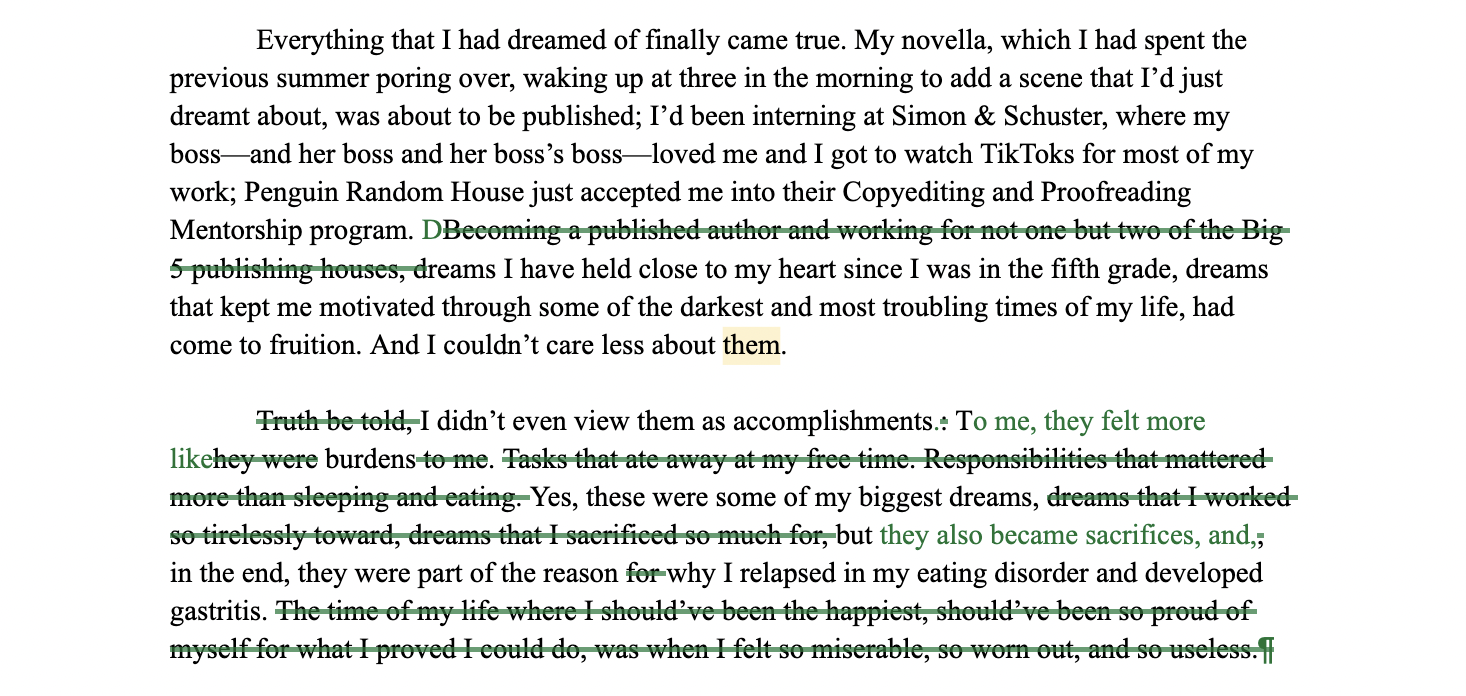
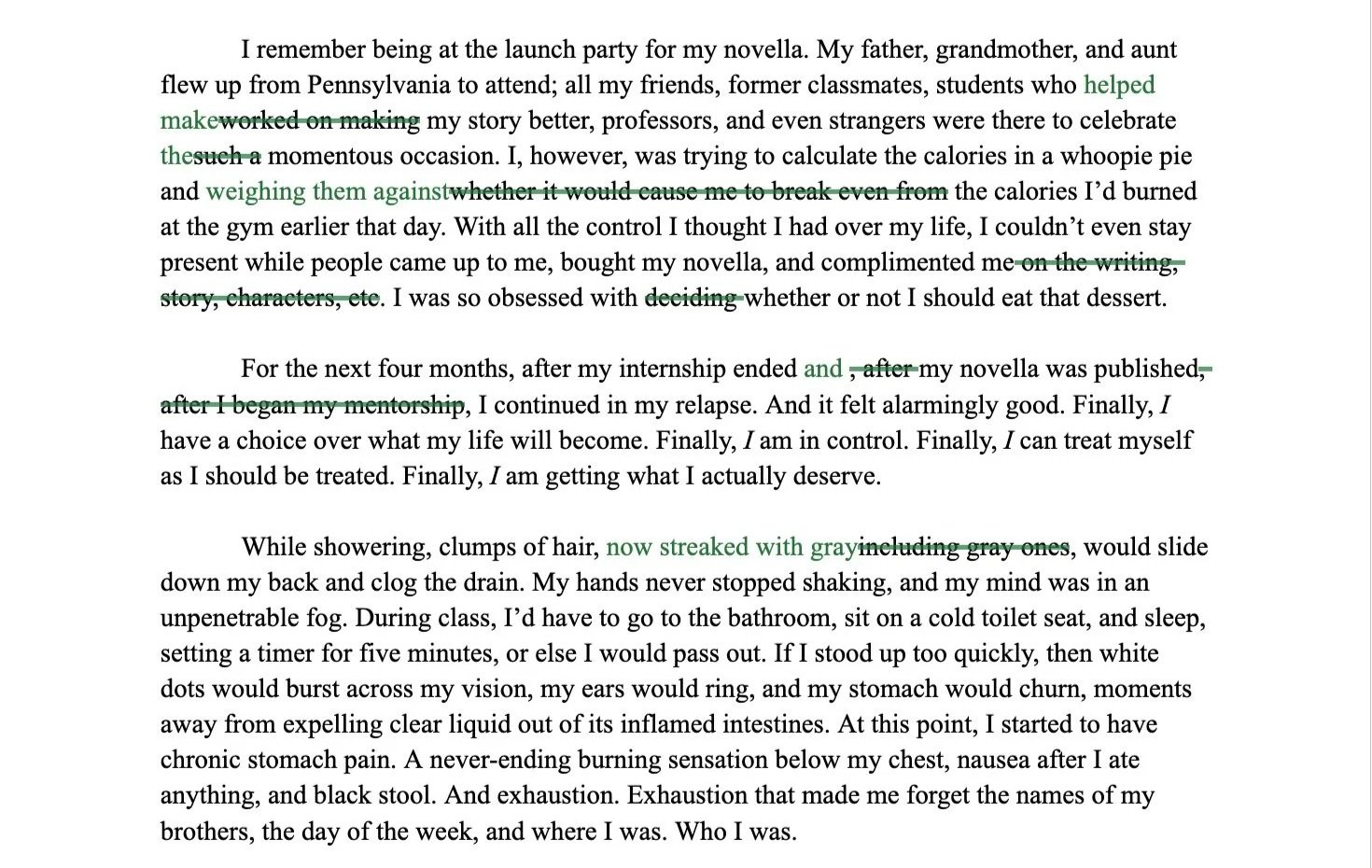
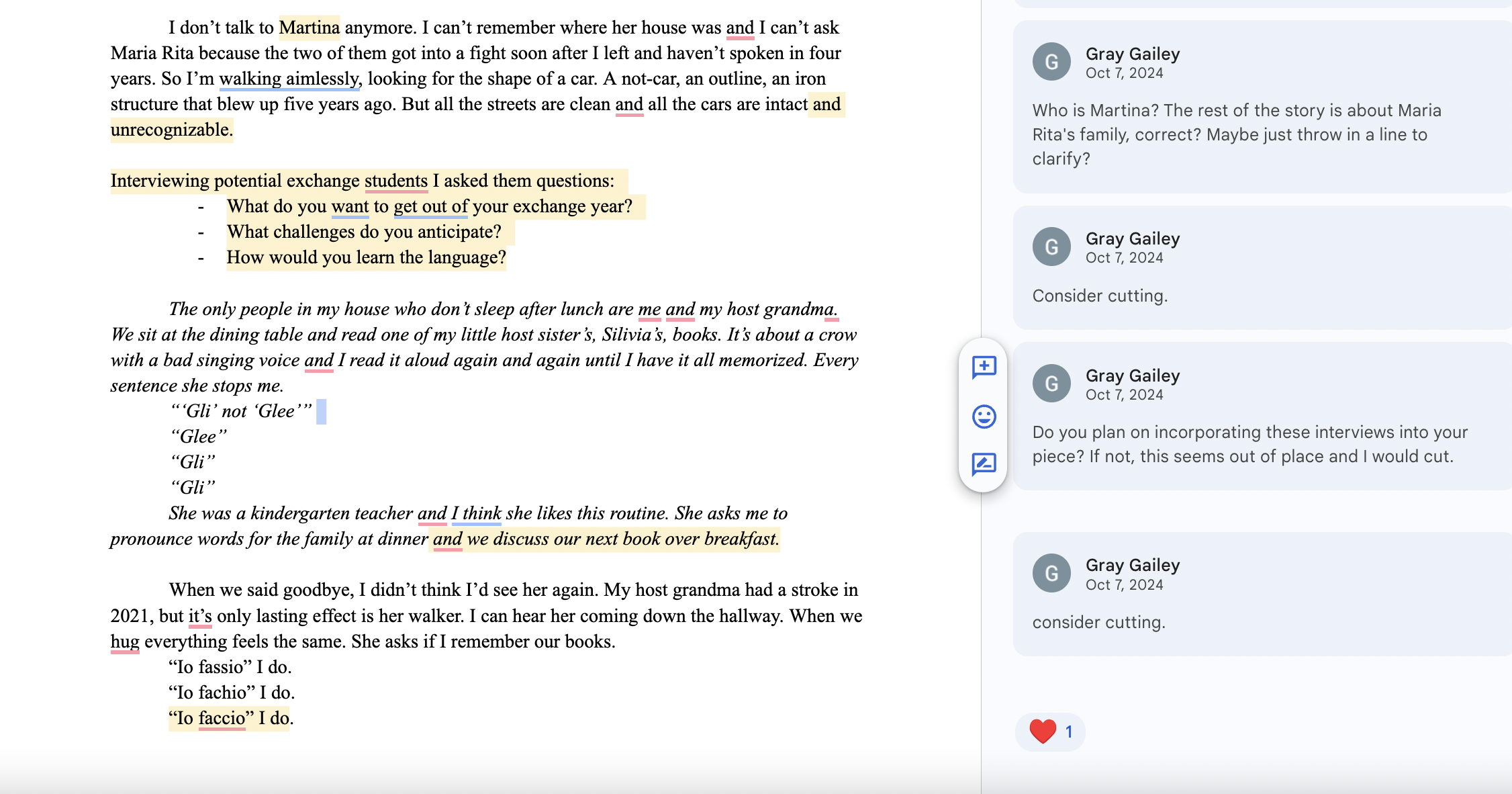
Brief Editor’s Note: “Great job, Liz, as always. Thanks for being so personal and vulnerable in this piece. My biggest note is to look through and see where you repeat yourself by rewording the same sentence a few different ways. I think there are quite a few lines that could be cut to strengthen the writing. In the end, do you want to provide resources? I think that would help universalize your piece as well, as right now it doesn't feel that much like a 'globe' piece. Maybe you can find a better way to incorporate that global aspect in ... maybe in the beginning, you can say that the "world felt like yours," or something. Up to you. I can't wait to read your second draft (due Oct. 12th) and help you make this piece even better!”
On Coming Back by Sydney Flaherty
Atlas Magazine: The “Reclamation” Issue, January 2025.



Brief Editor’s Note: “Solid ending! Great job, Sydney. I really got sucked into your story and love your writing style. Feel free to ignore some of my edits if you feel like they depart from your personal style. Please let me know if you need any help or just want to brainstorm the formatting. The format has grown on me, but if you do feel like re-ordering any of the events/paragraphs, that may be a big task to take on on your own. I'd be happy to help!”